
Your Clunker Has Value — Even Without a Title
Car removal without title is not only possible in most of the U.S. — it’s more common than you’d think.
Here’s the short answer if you need it fast:
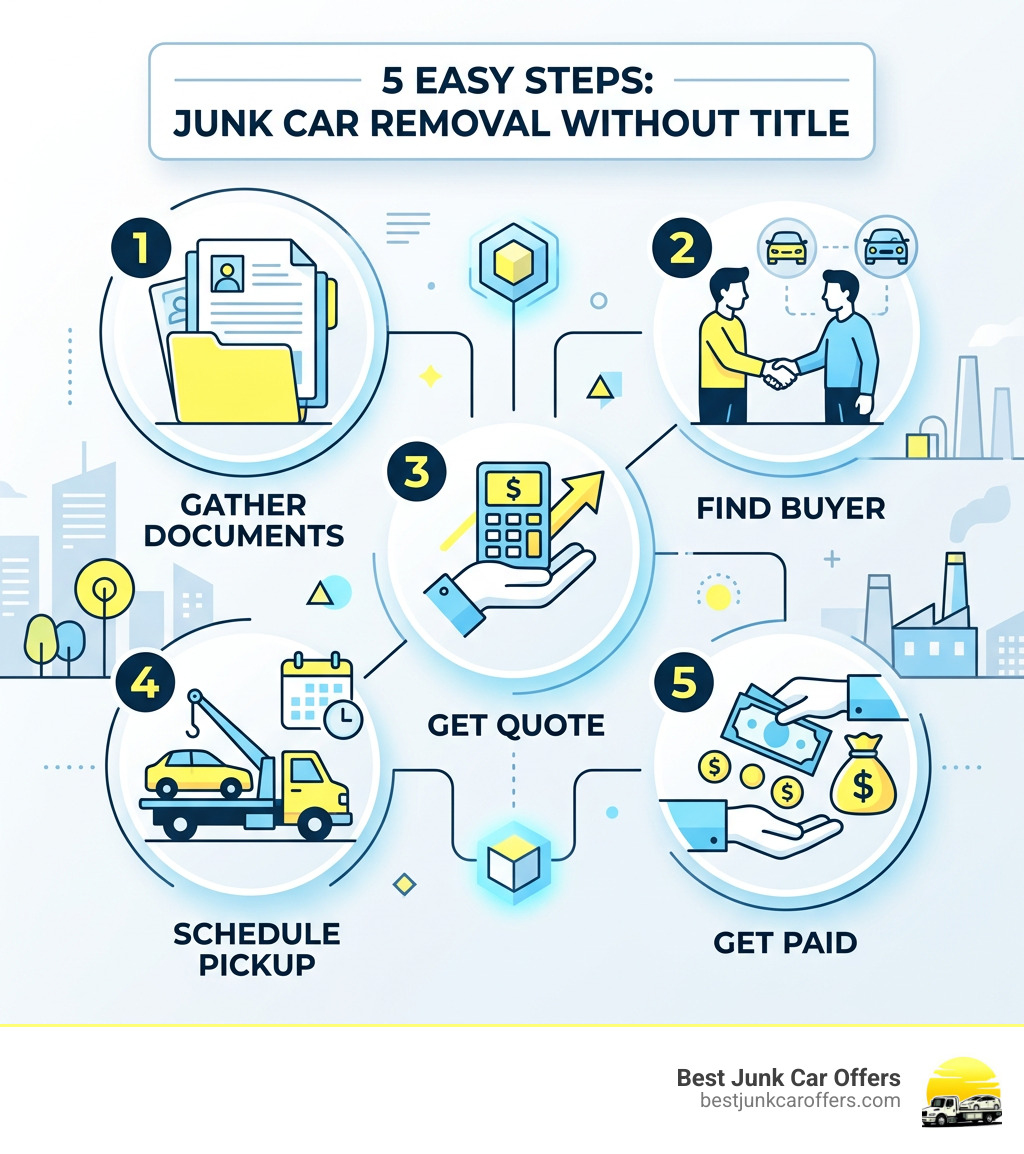
- Gather proof of ownership — registration, photo ID, insurance card, or service receipts with your VIN
- Check your state’s rules — some states (like Florida and Wisconsin) allow title-less sales with alternative documents
- Contact a junk car buyer that accepts no-title vehicles
- Get a quote, schedule free towing, and sign a bill of sale
- Get paid — expect up to $500, though offers may run $100–$300 less than with a title
That old car sitting in your driveway isn’t just an eyesore. Every week it sits there, it’s losing value — and if your HOA notices, you could be looking at fines on top of everything else.
The good news? A missing title doesn’t have to mean a dead end.
Most junk car buyers and licensed salvage yards deal with title-less vehicles every single day. They understand that titles get lost in moves, floods, and estate situations. They have paperwork solutions ready to go.
What trips people up is not knowing where to start — or worrying they’ll get scammed or lowballed because they’re in a weaker position without that piece of paper.
This guide walks you through exactly what to do, what documents you’ll need, what the law says in your state, and how to get the most cash possible for your vehicle — with or without a title.
Is Car Removal Without Title Legal?

The short answer is yes, but with a few “it depends” attached. Selling or removing a junk car without a title is legal in many jurisdictions, provided you can prove you actually own the hunk of metal taking up space in your yard.
Laws regarding vehicle titles exist primarily to prevent auto theft. If someone could just tow any car off the street and sell it for scrap without paperwork, we’d all be taking the bus to work tomorrow. However, state governments recognize that titles are pieces of paper, and humans are notoriously good at losing pieces of paper.
To stay on the right side of the law, most states require the buyer to be a licensed salvage yard or a professional auto recycler. These businesses are regulated and must notify the DMV before they crush or dismantle a vehicle. This allows the state to cross-reference the VIN (Vehicle Identification Number) against databases of stolen vehicles.
Understanding State Laws for Car Removal Without Title
Every state has its own “playbook” for how they handle car removal without title. While we operate in all 50 states, the requirements can shift significantly once you cross state lines.
- Florida: In the Sunshine State, the law is relatively flexible for older vehicles. Florida law allows for the scrapping of cars over ten years old without a title, provided they are sold to a licensed salvage yard. This is a lifesaver for residents in cities like Miami who might be facing HOA fines for an unused vehicle sitting on their property.
- Illinois: Things are a bit stricter here. In Illinois, salvage vehicles can generally only remain in consumer hands if the damage was due to hail or if the car is more than 9 years old. Junking certificates are often used to ensure these cars don’t accidentally end up back on the road illegally.
- Wisconsin: If you’re in the Badger State, you can often bypass the title requirement by providing a valid vehicle registration and a photo ID. A specialized document called the Wisconsin Junk Vehicle Bill of Sale is used to record the transaction and officially take the vehicle off the road.
- Other States: Many states have “age exemptions” (usually for cars 10–15 years old) where a bill of sale and a copy of your driver’s license are sufficient to prove ownership to a licensed recycler.
Handling Liens and Salvage History
If there is a lien on the car — meaning you still owe money to a bank or a dealership — the title isn’t actually yours yet; it belongs to the lender. Most reputable junk car buyers will not touch a car with an active lien. You’ll need to pay off the balance and get a lien release before the car can be legally removed or scrapped.
If you’re struggling with debt and that car loan is part of the problem, National Debt Relief could potentially help convince lenders to settle for less than you owe. It’s one way to clear the path toward getting that car off your hands.
As for salvage history, if your car was already “totaled” by an insurance company, it likely has a salvage brand on its record. This doesn’t stop you from selling it for scrap, but it does mean the car’s value is purely in its parts and metal weight, not its potential to be driven again.
The Step-by-Step Process for Car Removal Without Title
We’ve spent years refining the process to make car removal without title as painless as possible. When you work with us, we connect you with Peddle to ensure you get a fair offer and professional service regardless of your paperwork situation.
- Get an Instant Offer: You provide the year, make, model, and condition. Be honest about the missing title up front!
- Verification: We’ll ask for alternative documents to prove you own the car.
- Schedule Pickup: Once the offer is accepted, a tow truck is dispatched — usually within 24 to 48 hours.
- Hand Over Documents and Keys: You’ll sign the necessary paperwork (like a Bill of Sale or Power of Attorney) and hand over the keys.
- Get Paid: You receive your payment on the spot via check or cash, depending on the local carrier’s policy.
Proving Ownership Without a Title
If you don’t have the title, you need to build a “case” for your ownership. Think of it like a puzzle — the more pieces you have, the clearer the picture becomes for the buyer.
- Vehicle Registration: This is the most powerful alternative. If the registration is current (or even recently expired) and matches your photo ID, most buyers will move forward.
- Insurance Card: Proof that you’ve been insuring the vehicle in your name is a strong indicator of ownership.
- Service Receipts: Maintenance records that show your name and the vehicle’s VIN provide a paper trail of your connection to the car.
- VIN Report: You can obtain a VIN report from the National Insurance Crime Bureau (NICB). This shows the vehicle’s history and confirms it hasn’t been reported stolen.
- Photo ID: A valid state-issued driver’s license or ID is non-negotiable. The name must match the other documents you provide.
Finalizing the Bill of Sale and Pickup
The Bill of Sale is your legal shield. It records the date of the sale, the price paid, and the VIN. Most importantly, it should include a “Release of Liability.” This ensures that once the car is towed away, you aren’t responsible for anything that happens to it (like if it’s involved in an accident or gets a parking ticket while on the back of the tow truck).
In some cases, you may be asked to sign a Power of Attorney (POA) form. This sounds intimidating, but in car removal without title, it simply gives the salvage yard the legal authority to sign the title on your behalf once they process the paperwork with the DMV.
Don’t forget to remove your license plates! In many states, you are required to return these to the DMV or transfer them to another vehicle. Leaving them on the junk car can lead to administrative headaches later.
Cash Value and the Duplicate Title Dilemma
How much is your title-less clunker actually worth? While every car is different, the “no-title” status does impact the bottom line.
| Factor | With Title | Without Title |
|---|---|---|
| Average Payout | Up to $500+ | $200 – $400 |
| Buyer Risk | Low | Moderate |
| Processing Time | Instant | 1-3 Days (Verification) |
| Scrap Value | Full Market Rate | $100-$300 Deduction |
The deduction exists because the buyer has to do more legwork. They have to verify the VIN, file extra paperwork with the state, and assume a higher level of legal risk.
Is It Worth Getting a Duplicate Title?
This is the “million-dollar” (or at least the “two-hundred-dollar”) question. Obtaining a duplicate title from your local DMV typically costs between $25 and $60. However, the process is not fast — it usually takes between 30 and 50 days to receive the new document in the mail.
Is it worth the wait?
- Yes, if the car is worth more than $500. Having the title can increase your offer by $200 or more, which easily covers the DMV fee.
- No, if the car is a total “rust bucket” only worth its weight in scrap metal. If the difference in offers is only $100, and you have to wait nearly two months to get the title, you’re better off just taking the lower offer now and freeing up the space.
If you decide to go for it, you’ll need to fill out an “Application for Duplicate Title” at your DMV. It’s a bit of a chore, but it can put extra cash in your pocket. Speaking of extra cash, if you’re looking for ways to boost your bank account while you wait for that title, you can add up to $225 a month to your pocket with InboxDollars by taking short surveys.
Expected Payouts for Title-Less Cars
Most junk cars — even those without titles — can still fetch a respectable sum. You can generally expect to see offers up to $500, depending on several factors:
- Weight: Scrap metal is bought by the ton. The heavier the car (think SUVs vs. compacts), the higher the payout.
- Completeness: Is the engine still there? What about the transmission? A “complete” car is worth much more than a shell.
- Catalytic Converter: These contain precious metals like platinum and palladium. If yours is missing, the offer will drop significantly.
- Demand for Parts: If you have a popular model (like a Honda Civic or Ford F-150), the parts are easier for the yard to resell, leading to a better offer.
Avoiding Scams and Choosing Reputable Buyers
When you’re selling a car without a title, you’re a prime target for scammers. They know you’re eager to get rid of the car and might be worried about the legalities.
Red Flags in Car Removal Without Title
If you encounter any of the following, hang up the phone or walk away:
- Wire Transfers or Checks via Mail: Never accept payment that isn’t “on the spot.” Scammers often send fake checks that bounce days after your car has been towed away.
- Hidden Towing Fees: Reputable buyers (like us!) always include free towing in the quote. If a buyer shows up and tries to deduct a “towing fee” from your cash, tell them to leave.
- Unlicensed Buyers: Ask if they are a licensed salvage dealer. If they’re just some guy with a trailer from a Craigslist ad, you have zero legal protection if that car is later used in a crime or abandoned on the side of the road.
- Verbal-Only Quotes: Always get your offer in writing (or via a confirmed digital quote). This prevents “price chipping” at the time of pickup.
While you’re protecting your car’s value, don’t forget to protect your other assets. Comparing car insurance quotes with Insurify takes just five minutes and can save you up to $996 per year — money that’s much better off in your savings account than the insurance company’s pocket.
Benefits of Professional Removal Services
Using a professional service like Best Junk Car Offers provides peace of mind that a “random buyer” simply can’t offer.
- Space Clearing: That eyesore is gone within 24–48 hours.
- HOA Compliance: Avoid those pesky $50-a-day fines for “non-operational vehicles.”
- Environmental Responsibility: We ensure your car is recycled according to state regulations. Fluids are drained safely, and over 80% of the vehicle’s materials are reused.
- Paperwork Handling: We help navigate the specific forms your state requires for title-less transfers.
Frequently Asked Questions about Junk Car Removal
Can I sell a car if the title is in someone else’s name?
Generally, no. You cannot sell property that isn’t yours. However, there are exceptions. If the title holder is deceased, you may be able to sell the car using “additional documentation” like a death certificate and executor papers. If you’re selling for a friend, they must sign the title (or the appropriate no-title paperwork) in advance.
What happens if I have a lien on my junk car?
You must resolve the lien before the car can be scrapped. Junkyards will not accept vehicles with active liens because the lender technically owns the car. Once you pay it off, the lender will send you a lien release or a “clean” title. If you’re looking for a way to manage high-interest debt so you can finally clear that car title, AmONE can help you borrow up to $50,000 with fixed rates to consolidate your payments.
Do I need to be present when the tow truck arrives?
We understand that life is busy. While it’s always best to be there to receive payment and sign the final Bill of Sale, we can often make it work if you can’t be present. You’ll need to coordinate with the tow partner in advance, ensure the paperwork is signed and left in a secure location (like the glove box), and arrange for payment to be sent to you afterward.
Conclusion
Losing a title feels like a major roadblock, but it doesn’t have to be the end of the road for your junk car. Whether your car is a 20-year-old rusted sedan or a 10-year-old SUV with a blown engine, it still has value in the auto recycling ecosystem.
By gathering your registration, verifying your state’s specific rules, and choosing a reputable buyer, you can turn that “monument of metal curses” into cold, hard cash. We pride ourselves on offering a transparent, nationwide service that takes the headache out of car removal without title.
Ready to reclaim your driveway and put some money in your pocket?